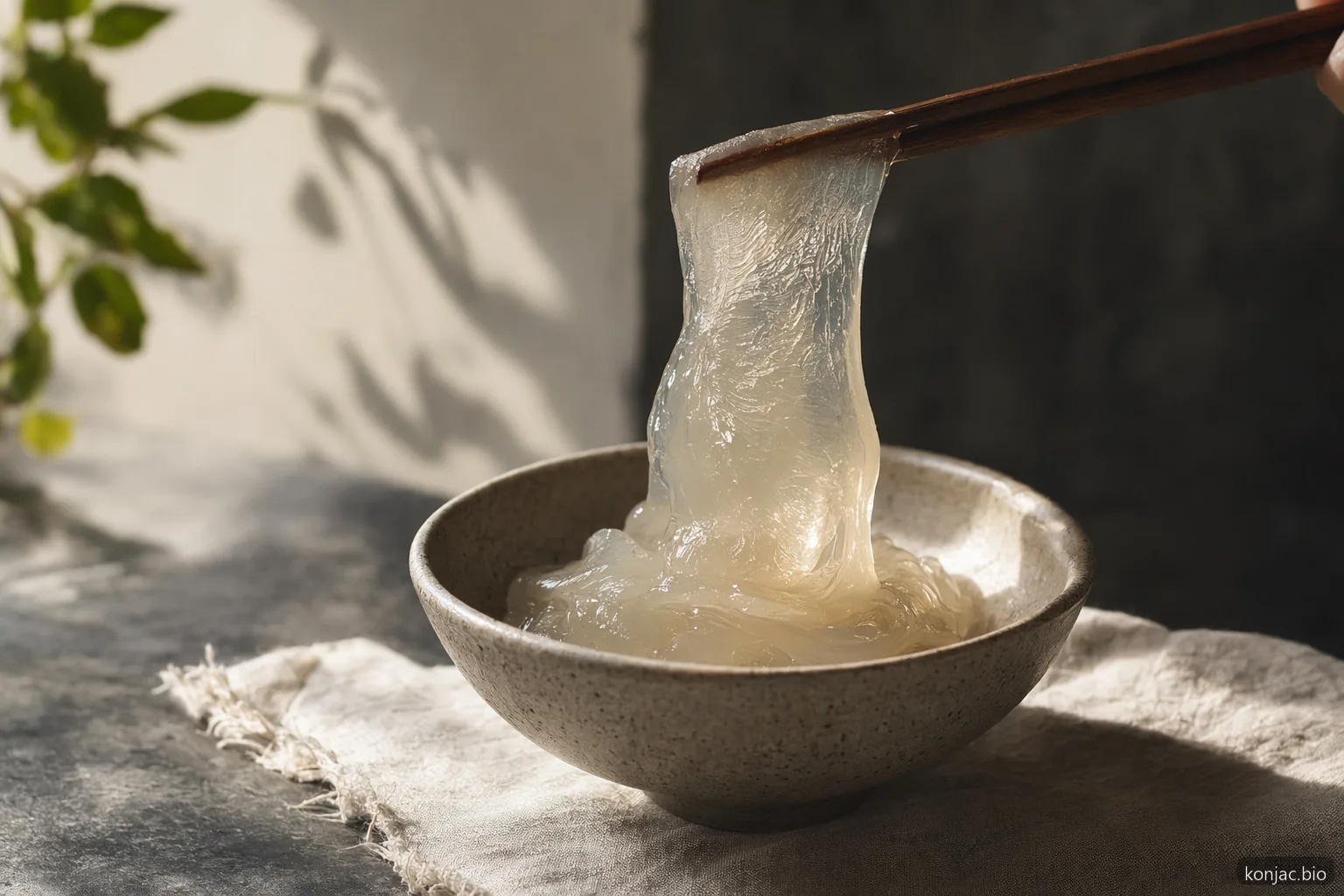
Konjac Bio Limited supplies konjac gum under the food additive code E425, covering both E425(i) konjac gum and E425(ii) konjac glucomannan. We source both grades from vetted producing factories across China's konjac-growing regions and ship worldwide from Shanghai. Typical uses are thickening, gelling and stabilising in dairy desserts, plant-based meat and seafood analogues, sauces, gluten-free bakery and ice cream.
Product · request a quote
Konjac Gum E425 (i) and (ii) — Thickener, Gelling Agent, Stabiliser
Konjac gum E425(i) and E425(ii) konjac glucomannan for thickening, gelling and stabilising. MOQ 500 kg, FOB Shanghai. Request specs and a sample.
Grades and formats
What we can source
| Grade / format | Typical specification | Typical use |
|---|---|---|
| E425(i) konjac gum | >= 75% carbohydrate; viscosity >= 3,000 mPa·s at 25 °C; moisture <= 12%; ash <= 5%; protein <= 3%; pH 4.0-7.0; lead <= 2 mg/kg, arsenic <= 3 mg/kg — EU specification | general-purpose thickening, cost-sensitive formulations |
| E425(ii) konjac glucomannan | >= 95% total dietary fibre, dry basis; viscosity >= 20,000 mPa·s at 25 °C; moisture <= 8%; ash <= 2%; protein <= 1.5%; pH 5.0-7.0; sulphite as SO2 <= 4 mg/kg; lead <= 1 mg/kg — EU specification | gelling with alkali, meat and seafood analogues, higher-clarity gels |
| Commercial refined grade | viscosity 25,000-36,000 mPa·s at 25 °C, per producer spec sheet, confirm per lot | dairy desserts, thick sauces and dressings |
Specification
Typical specification
Typical ranges from the producers we work with. Every value is confirmed per lot on the producing factory's specification sheet and COA before a proforma invoice is issued.
| Parameter | Typical | Note |
|---|---|---|
| Carbohydrate / dietary fibre content | E425(i) >= 75% carbohydrate; E425(ii) >= 95% total dietary fibre, dry basis | EU specification; confirm per lot with COA from producing factory |
| Viscosity (1% solution, 25 °C) | E425(i) >= 3,000 mPa·s; E425(ii) >= 20,000 mPa·s | EU specification minimums; commercial refined grades 25,000-36,000 mPa·s per producer spec sheet |
| Moisture | E425(i) <= 12%; E425(ii) <= 8% | EU specification |
| pH (1% solution) | E425(i) 4.0-7.0; E425(ii) 5.0-7.0 | EU specification |
| Sulphite as SO2 | E425(ii) <= 4 mg/kg | EU specification; other grades per producer COA |
| Ash | E425(i) <= 5%; E425(ii) <= 2% | EU specification |
| Protein (N x 5.7) | E425(i) <= 3%; E425(ii) <= 1.5% | EU specification |
| Heavy metals | lead <= 2 mg/kg, arsenic <= 3 mg/kg for E425(i); lead <= 1 mg/kg for E425(ii) | EU specification; mercury and cadmium per producer COA |
| Total plate count | <= 1,000 cfu/g | EU specification |
| Yeast and mould | <= 100 cfu/g | EU specification |
| E. coli | negative in 5 g | EU specification |
| Salmonella | absent in 12.5 g | EU specification |
| Appearance | white to cream / light tan free-flowing powder | visual, confirm per lot |
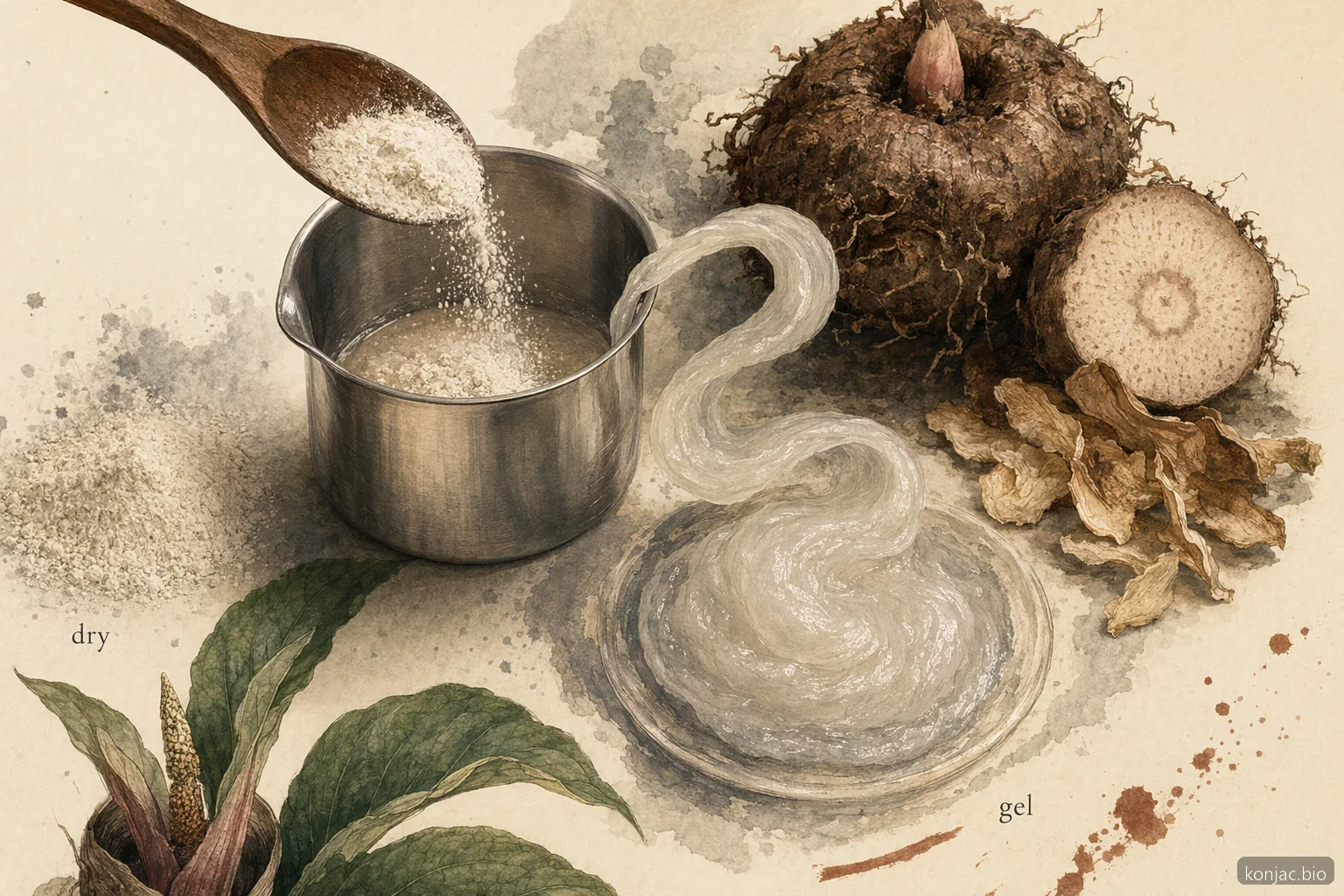
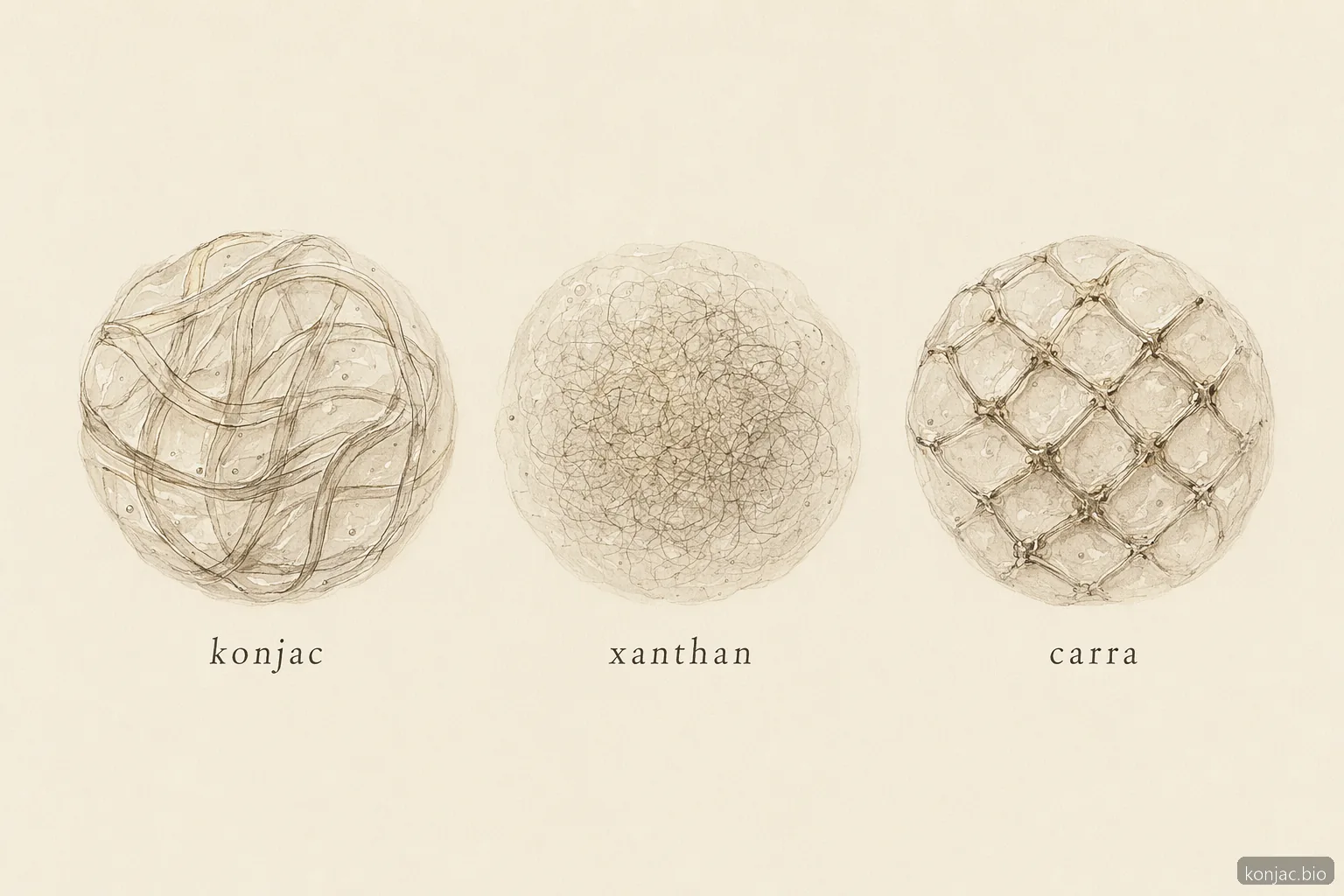
| Gelling behaviour | thermo-irreversible gel with food-grade alkali; synergistic gel with carrageenan, xanthan, locust bean gum | trial per application recommended |
Commercial terms
MOQ, packaging, lead time
Typical terms, confirmed per order on the proforma invoice.
| MOQ | 500 kg (mixed grades on request) |
| Packaging | 25 kg bag, inner food-grade PE liner, outer kraft, or 25 kg drum |
| Lead time | Confirmed on the proforma invoice |
| Incoterms | FOB Shanghai or CIF destination port; EXW and DAP on request |
| Samples | Small samples available; buyer pays courier |
| Payment | T/T; terms stated on the proforma invoice |
| Shelf life | 24 months, dry and sealed |
| Documents | Specification sheet, Certificate of Analysis (COA), packing list, commercial invoice |

No. 01
Applications
Konjac gum E425 is used as a thickener, gelling agent and stabiliser across several food categories:
- Thermo-irreversible gels formed with food-grade alkali (used in konjac-based foods and analogue products)
- Synergistic gels with carrageenan, xanthan gum or locust bean gum for firmer, more elastic textures
- Dairy desserts and puddings, for body and stabilisation
- Plant-based meat and seafood analogues, for bite and structure
- Sauces and dressings, as a thickener at low use levels
- Gluten-free bakery, for structure and moisture retention
- Ice cream, as a stabiliser to control ice crystal growth
See konjac gum formulation for typical usage levels and processing notes, and the konjac gum overview for background on the ingredient family.
No. 02
How we source it
Konjac Bio Limited is a sourcing and trading company; we do not own a factory. We source konjac gum from vetted producing factories in China's konjac-growing regions, including Yunnan, Hubei, Sichuan, Guizhou and Shaanxi. Each order is matched to a producing factory that can meet the requested grade, whether E425(i) konjac gum or E425(ii) konjac glucomannan, and the volume required.
See our related powder grades on the konjac glucomannan powder and konjac flour pages, or the full product range.
No. 03
Packaging, MOQ and lead time
MOQ is 500 kg, with mixed grades available on request. Standard packaging is a 25 kg bag with an inner food-grade PE liner and outer kraft, or a 25 kg drum; alternative packaging can be requested at order stage. Lead time is confirmed on the proforma invoice (PI) once grade and volume are set. Shipping is FOB Shanghai or CIF to the destination port as standard, with EXW and DAP available on request.
No. 04
Quality documents and testing
Each shipment is supplied with a specification sheet, a Certificate of Analysis (COA) issued by the producing factory, a packing list and a commercial invoice. Certificates for each lot are available on request from the producing factory. Small samples are available before ordering; the buyer pays courier.
No. 05
Regulatory notes
E425 (konjac gum and konjac glucomannan) is permitted as a food additive in the EU under EU Regulation 231/2012, with quantum-satis limits in listed food categories, meaning no fixed maximum level is set for those uses. E425 has been assessed in the EFSA re-evaluation of E425. E425 is not permitted in jelly mini-cups and jelly confectionery in the EU. Permitted uses, limits and labelling requirements vary by market, so the buyer should confirm local regulation for the destination country and intended food category before finalising a formulation. This section is general information, not regulatory advice.
Q&A
Frequently asked questions
01 What is the difference between E425(i) and E425(ii)?
E425(i) is konjac gum, defined under EU specification as at least 75% carbohydrate. E425(ii) is konjac glucomannan, a more refined grade defined as at least 95% total dietary fibre on a dry basis. Both fall under the E425 food additive designation; the choice depends on the clarity, gel strength and cost target of the formulation.
02 Do you hold certificates for konjac gum E425?
Konjac Bio Limited does not hold certificates directly. Certificates for each lot are available on request from the producing factory.
03 What is the minimum order quantity?
MOQ is 500 kg per grade, with mixed grades available on request. Contact us for smaller trial quantities and sample availability.
04 Can konjac gum E425 be used in jelly confectionery?
E425 is not permitted in jelly mini-cups and jelly confectionery in the EU. Buyers targeting the EU market should confirm the intended food category and format against current local regulation before ordering.
05 Which gums does konjac gum E425 pair well with?
It forms synergistic gels with carrageenan, xanthan gum and locust bean gum, and a thermo-irreversible gel when combined with a food-grade alkali. See the konjac gum formulation guide for typical ratios.
06 Can I get a sample before ordering?
Yes. Small samples are available before ordering; the buyer pays courier.
Related
Request a quote
Request konjac gum E425 specs and a quote
Tell us the grade, target viscosity and volume you need. We'll confirm specification, MOQ and lead time from our vetted producing factories.