What is shirataki rice konjac rice?
Shirataki rice konjac rice is rice-shaped shirataki made from konjac glucomannan, a soluble fiber extracted from the corm of Amorphophallus konjac.
The word shirataki is often used for noodle shapes, but many producers cut or extrude the same gel into rice-sized pieces. The base formula is simple: konjac flour, water, and a food-grade alkaline setting agent such as calcium hydroxide.
Konjac glucomannan has been reviewed as a highly viscous soluble fiber, and its water-binding behavior explains the gel texture in shirataki formats [PubMed review](https://pubmed.ncbi.nlm.nih.gov/21751854/). The plant itself, Amorphophallus konjac, is a recognized botanical species listed by Kew's Plants of the World Online [Kew record](https://powo.science.kew.org/taxon/urn:lsid:ipni.org:names:84437-1).
For a broader overview of ingredients, formats, and use cases, see the parent guide: Konjac Rice: The Low-Carb Rice Substitute Guide.
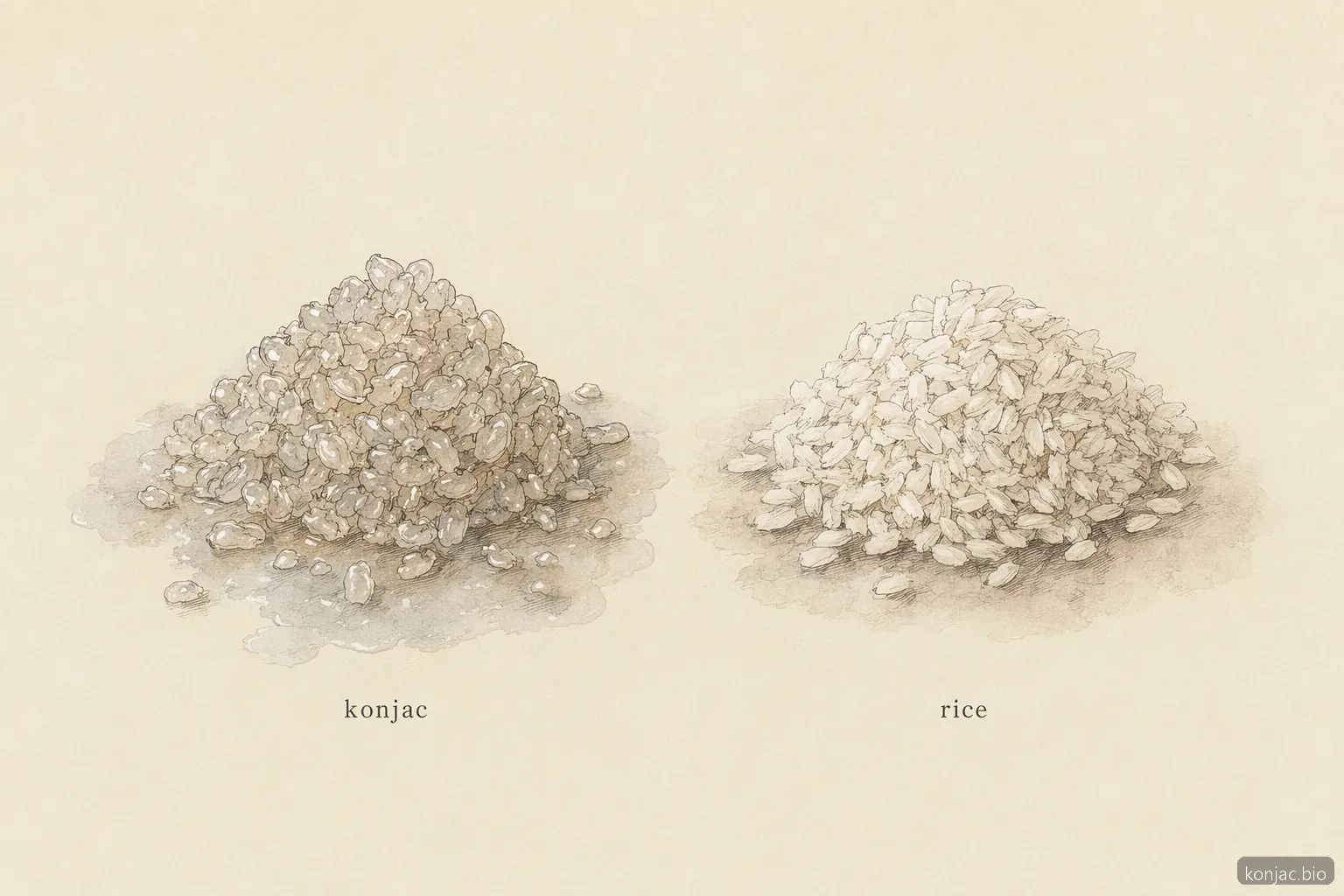
How is shirataki rice konjac rice different from white rice?
Shirataki rice konjac rice is different from white rice because it is a hydrated fiber gel, while white rice is a cooked cereal grain rich in starch.
Cooked white rice delivers starch, a soft grain bite, and mild sweetness. Konjac rice delivers volume, a springy chew, and a neutral base that absorbs sauces. The difference matters most in dishes where rice is the main texture, such as sushi rice or risotto.
| Feature | Shirataki rice konjac rice | Cooked white rice |
|---|---|---|
| Main source | Konjac glucomannan gel | Rice grain starch |
| Typical calories | About 5 to 20 calories per serving, label-dependent | About 205 calories per cooked cup |
| Texture | Springy, slick, translucent | Soft, starchy, grainy |
| Best role | Low-carb volume and sauce carrier | Staple carbohydrate base |
USDA FoodData Central lists cooked enriched long-grain white rice at about 205 calories per 158 g cup [USDA data](https://fdc.nal.usda.gov/fdc-app.html#/food-details/168878/nutrients). Konjac rice varies by maker, so the Nutrition Facts panel is the most reliable source for calories, carbohydrate, fiber, and sodium per serving [FDA label](https://www.fda.gov/food/nutrition-facts-label/how-understand-and-use-nutrition-facts-label).
Nutrition snapshot: shirataki rice, konjac rice, and cooked rice
The nutrition advantage of konjac rice is volume with very low energy intake. Most products are mostly water, with a small amount of konjac flour supplying glucomannan fiber.
Glucomannan has been evaluated by the European Food Safety Authority. EFSA authorized the claim: "Glucomannan in the context of an energy restricted diet contributes to weight loss" when specific use conditions are met, including 3 g daily in three 1 g doses with water before meals [EFSA opinion](https://www.efsa.europa.eu/en/efsajournal/pub/1798).
That claim does not mean every bowl of konjac rice produces the same result. Product serving size, daily intake, hydration, the rest of the meal, and total energy intake all matter. For everyday label reading, compare per-serving calories, total carbohydrate, dietary fiber, and sodium.
- Calories: usually far below cooked rice, because the product is water-rich.
- Carbohydrate: often low, but total carbs and net carbs depend on the label.
- Fiber: supplied mainly as glucomannan, a soluble fiber.
- Sodium: varies, especially in seasoned or shelf-stable packs.
- Satiety: soluble fiber may support fullness as part of a balanced meal [NIH fiber](https://ods.od.nih.gov/factsheets/Fiber-HealthProfessional/).
For a deeper macro-by-macro view, use the sibling guide konjac rice nutrition.
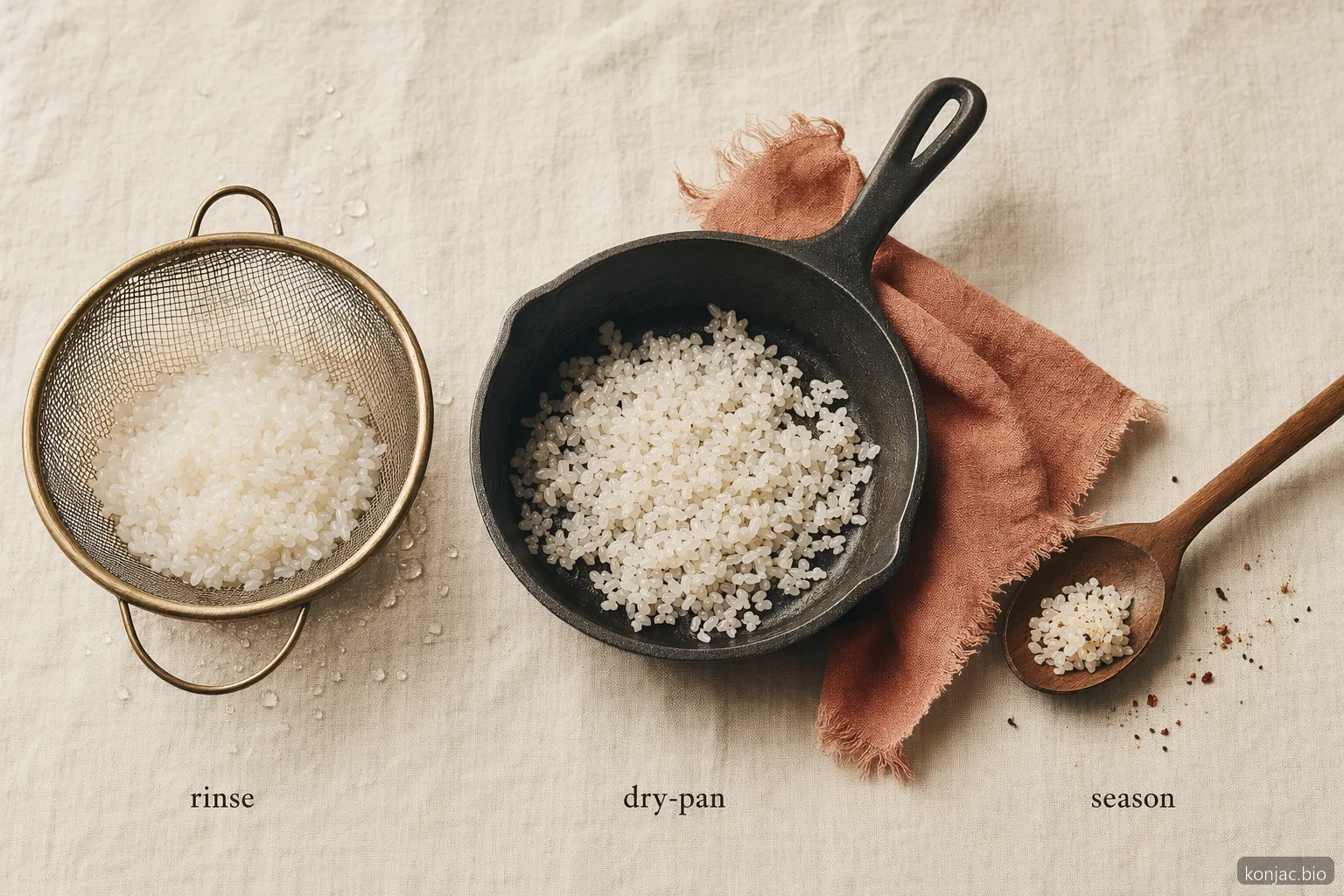
How do you cook shirataki rice konjac rice so it is not watery?
You cook shirataki rice konjac rice best by rinsing it, draining it thoroughly, and dry-heating it before adding sauce or seasoning.
The liquid in the pouch can carry a mild alkaline aroma. Rinsing removes most of it, while dry-pan heating drives off surface water and gives sauces a better chance to cling.
- Drain: pour the pouch into a fine sieve.
- Rinse: rinse under cool running water for 30 to 60 seconds.
- Boil briefly: simmer for 2 minutes if the aroma is strong.
- Dry-pan: heat in a nonstick pan for 3 to 5 minutes, stirring often.
- Season late: add soy sauce, curry, broth, herbs, or stir-fry sauce after moisture drops.
Konjac rice works best when paired with high-flavor ingredients: sesame oil, ginger, garlic, chili crisp, curry paste, tomato sauce, miso, lime, or black pepper. For a more familiar plate, blend 50% konjac rice with 50% cooked rice. That mix lowers the calorie density while keeping more of the starchy bite people expect from rice.
For cooking ratios, dry-pan timing, and meal-prep storage, see how to cook konjac rice.
Buying checklist for clean labels, foodservice, and retail
A good konjac rice spec starts with the ingredient list, process controls, and the target eating experience. The simplest labels usually include water, konjac flour, and calcium hydroxide, while some products include oat fiber, soy fiber, seaweed powder, or seasoning systems.
Retail buyers should compare drained weight, serving count, pouch format, shelf life, sodium, and whether the product is shelf-stable or refrigerated. Foodservice buyers should test holding performance, sauce cling, and texture after reheating.
- Ingredient clarity: confirm the konjac source, setting agent, and added fibers.
- Format: wet pouch, ambient cup, refrigerated pouch, or frozen blend.
- Texture target: rice-like pieces, pearl shape, chopped grain, or mixed grain blend.
- Certification needs: common requirements include HACCP, ISO 22000, BRCGS, halal, kosher, or gluten-free validation.
- Safety context: konjac rice is not the same product format as mini-cup gel candies, which FDA has flagged for choking risk due to size, shape, and gel firmness [FDA alert](https://www.fda.gov/food/alerts-advisories-safety-information/fda-warns-consumers-not-eat-mini-cup-gel-candy-products-imported-taiwan).
For B2B teams, konjac.bio sources konjac ingredients and finished konjac formats at wholesale scale. Contact konjac.bio for specifications, pack formats, and pricing.
Frequently asked questions
01 Are shirataki rice and konjac rice the same thing?
02 Does shirataki rice konjac rice taste like regular rice?
03 Is shirataki rice konjac rice low in calories?
04 Can konjac rice help with weight management?
05 How do I remove the smell from konjac rice?
06 Can I use shirataki rice konjac rice for fried rice?
- Scientific Opinion on health claims related to konjac mannan, glucomannan · EFSA Journal · 2010
- Glucomannan and obesity: a critical review · PubMed · 2011
- Fiber Fact Sheet for Health Professionals · NIH Office of Dietary Supplements · 2024
- How to Understand and Use the Nutrition Facts Label · U.S. Food and Drug Administration · 2024
- Rice, white, long-grain, regular, enriched, cooked · USDA FoodData Central · 2019