What is shirataki konjac rice?
Shirataki konjac rice is a rice-shaped gel food made from water, konjac flour, and an alkaline setting agent, usually calcium hydroxide.
Konjac flour comes from the corm of Amorphophallus konjac. Its key functional component is glucomannan, a water-soluble polysaccharide that forms a firm, springy gel when hydrated and set. Glucomannan has been studied for body weight, lipid, and glucose markers in controlled nutrition contexts [PubMed meta](https://pubmed.ncbi.nlm.nih.gov/18842808/).
The word shirataki is best known from long konjac noodles, but the same gel can be cut into rice-like grains. That is why shirataki rice, konjac rice, and miracle rice are often used for the same type of food. The product is not a cereal grain, does not contain rice starch unless blended, and does not cook like raw rice.
For the broader category, including dry blends and meal applications, see our parent guide to [konjac rice](/konjac-rice/).
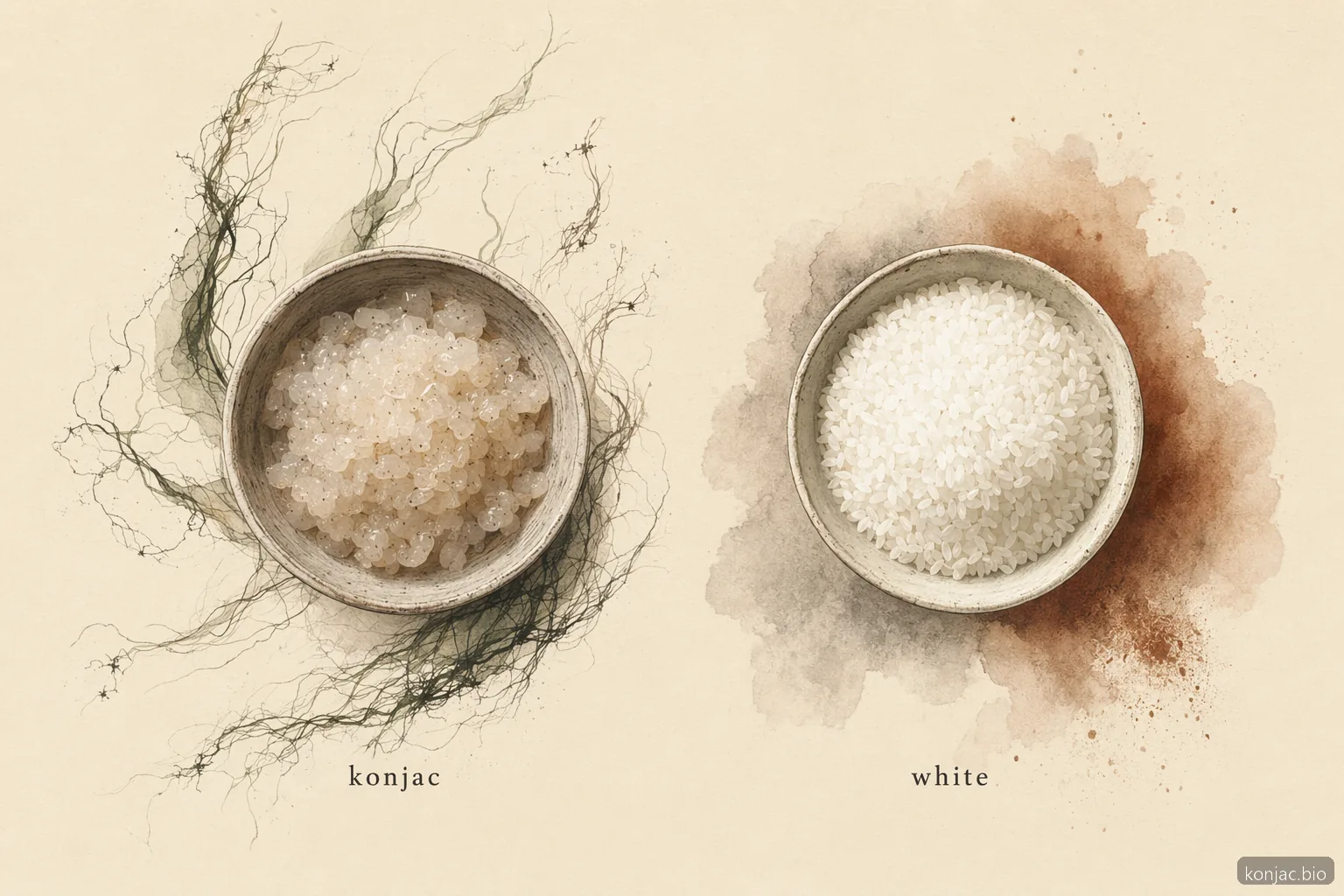
How does shirataki konjac rice compare with white rice?
Shirataki konjac rice usually has far fewer calories and digestible carbohydrates than cooked white rice because it is mostly water and glucomannan fiber.
Cooked white long-grain rice contains about 130 calories and 28.2 grams of carbohydrate per 100 grams in USDA FoodData Central [USDA rice](https://fdc.nal.usda.gov/fdc-app.html#/food-details/168878/nutrients). Shirataki konjac rice varies by formula, but many products list roughly 5 to 15 calories per 100 grams and very low net carbohydrates because water is the main ingredient.
| Feature | Shirataki konjac rice | Cooked white rice |
|---|---|---|
| Main material | Water, konjac flour, calcium hydroxide | Rice grain starch |
| Calories | Typically very low, check label | About 130 kcal per 100 g |
| Carbohydrates | Usually very low digestible carbs | About 28.2 g per 100 g |
| Texture | Springy, gel-like, lightly chewy | Soft, starchy, fluffy |
| Best use | Low-carb bowls, saucy dishes, blends | Meals needing starch, aroma, and grain bite |
Glucomannan is a fiber, but shirataki rice is not automatically a high-fiber food. The FDA Daily Value for fiber is 28 grams per day on a 2,000 calorie diet [FDA fiber](https://www.fda.gov/food/new-nutrition-facts-label/daily-value-new-nutrition-and-supplement-facts-labels). A serving of konjac rice may contribute only a few grams, depending on the amount of konjac flour used.
For health claim wording, the EFSA-authorized claim is exact: "Glucomannan in the context of an energy restricted diet contributes to weight loss" [EFSA claim](https://www.efsa.europa.eu/en/efsajournal/pub/1798). EFSA conditions include 3 grams of glucomannan daily in three 1 gram doses, with 1 to 2 glasses of water before meals.
How do you cook shirataki konjac rice so it tastes better?
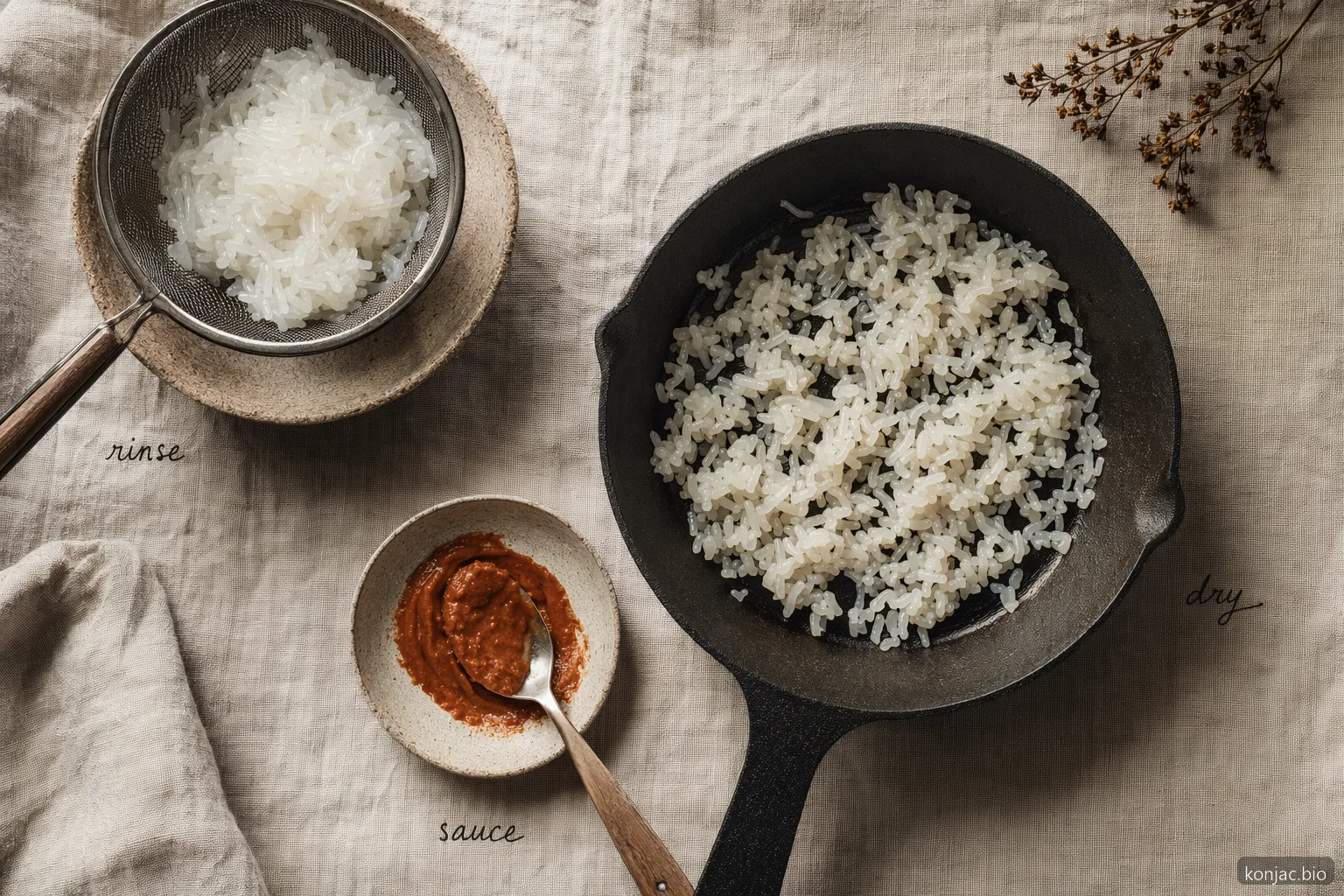
You cook shirataki konjac rice best by rinsing it, draining it well, dry-heating it for 2 to 3 minutes, then adding sauce, aromatics, or protein.
The liquid in the pouch can smell earthy because of the konjac gel and processing water. Rinsing removes most of that aroma. Dry-heating drives off surface moisture, which helps the grains hold sauce instead of watering it down.
- Drain: Empty the pouch into a fine strainer.
- Rinse: Rinse under cold running water for 30 to 60 seconds.
- Dry-pan: Heat in a nonstick or stainless pan for 2 to 3 minutes, stirring often.
- Season: Add soy sauce, curry paste, garlic, chili crisp, sesame oil, or tomato sauce.
- Finish: Add cooked vegetables, egg, tofu, fish, chicken, or legumes.
Do not boil pouch-packed konjac rice like raw rice. It is already hydrated and set, so long boiling usually makes it wetter, not better. For a stronger rice-like bite, mix 70 percent drained konjac rice with 30 percent cooked white or brown rice.
For a step-by-step method with timing, pan choices, and common mistakes, see our guide on [how to cook konjac rice](/how-to-cook-konjac-rice/).
Where shirataki konjac rice fits in real meals
Shirataki konjac rice works best in meals where sauce, seasoning, and toppings carry the flavor. It is less convincing in plain rice applications because it does not have the aroma, starch, or soft grain structure of jasmine, basmati, sushi rice, or short-grain rice.
Good uses include curry bowls, fried rice, burrito bowls, poke-style bowls, kimchi rice, tomato rice, and meal-prep bases. A practical serving is 150 to 200 grams drained konjac rice, plus 100 to 200 grams vegetables and 20 to 40 grams sauce, depending on the dish.
For texture, use one of three formats:
- Pure konjac: Best for very low-carb meals with strong sauces.
- Blended rice: Best for better bite, using 20 to 40 percent cooked grain.
- Vegetable mix: Best for volume, using cauliflower, cabbage, mushrooms, or zucchini.
Konjac rice and cauliflower rice solve different problems. Konjac rice is neutral, springy, and shelf-stable when packed wet. Cauliflower rice is vegetable-based, more aromatic, and easier to brown in a pan. For a side-by-side decision guide, see [konjac vs cauliflower](/konjac-rice-vs-cauliflower-rice/).
Safety, labeling, and buying checklist for shirataki konjac rice
Shirataki konjac rice is typically consumed as a hydrated food, but labels, portion size, and water intake still matter because glucomannan is a water-binding fiber.
The FDA has warned that konjac mini-cup gel candies can pose a choking hazard because the gel may not dissolve easily [FDA hazard](https://www.fda.gov/food/alerts-advisories-safety-information/konjac-mini-cup-gel-candies-pose-choking-hazard). That warning is about small gel candies, not loose rice-shaped konjac in a meal bowl, but it highlights why format and chewing matter.
Use this checklist before buying:
- Ingredients: Look for water, konjac flour, and calcium hydroxide as the basic formula.
- Drained weight: Compare drained grams, not only pouch weight.
- Fiber grams: Check whether the serving contributes meaningful fiber or mostly volume.
- Sodium: Choose lower-sodium formats if the dish already uses salty sauces.
- Texture: Rice-shaped pieces suit bowls, while chopped noodles suit stir-fries.
- Certifications: For commercial supply, ask about HACCP, ISO 22000, allergen controls, and lot traceability.
For food manufacturers, konjac.bio sources konjac ingredients at wholesale volumes for private label rice, noodle, and blend formats. Contact us through [wholesale konjac](/contact/) for specifications, samples, and pricing.
Frequently asked questions
01 Is shirataki konjac rice the same as konjac rice?
02 Does shirataki konjac rice taste like white rice?
03 Is shirataki konjac rice keto-friendly?
04 Can glucomannan in shirataki konjac rice help with weight management?
05 Why does shirataki konjac rice smell odd when opened?
06 Can you meal prep shirataki konjac rice?
- Scientific Opinion on the substantiation of health claims related to konjac mannan and reduction of body weight · EFSA Journal · 2010
- Effect of glucomannan on plasma lipid and glucose concentrations, body weight, and blood pressure: systematic review and meta-analysis · American Journal of Clinical Nutrition · 2008
- FoodData Central: Rice, white, long-grain, regular, cooked, enriched · USDA FoodData Central · 2019
- Daily Value on the Nutrition and Supplement Facts Labels · U.S. Food and Drug Administration · 2024
- Konjac Mini-Cup Gel Candies Pose Choking Hazard · U.S. Food and Drug Administration · 2024