
What are konjac gummies?
Konjac gummies are chewable gels or supplements formulated with konjac glucomannan for viscosity, structure, fiber content, or a combination of those functions.
The functional ingredient is usually konjac gum, also known as konjac mannan or glucomannan. It is extracted from the corm of Amorphophallus konjac, and its water-binding behavior is why it appears in gels, noodles, beverages, and thickened foods, as summarized in a KGM review.
In confectionery, konjac is rarely used in isolation. A brand may pair it with pectin for a fruit-style bite, carrageenan for elastic gel strength, agar for a firmer break, or starch for lower cost and opacity. The target is not only chew, but also heat stability, water control, clean slicing, and consistent dosing.
For a broader ingredient background, regulatory naming, and E425 context, see the parent guide: konjac gum. If your product also compares konjac with other hydrocolloids, the related guide on konjac vs xanthan gum helps clarify when viscosity, suspension, or gel texture matters most.

How do konjac gummies get their texture?
Konjac gummies get their texture when glucomannan hydrates in water, increases viscosity, and interacts with sugar, acid, minerals, heat, and other hydrocolloids.
Glucomannan is valued because a small inclusion can strongly change mouthfeel. Published summaries describe konjac glucomannan as a high molecular weight, water-soluble polysaccharide with notable viscosity and gel-forming behavior under suitable formulation conditions KGM review.
Gummy texture is controlled by 5 practical variables:
- Hydration: glucomannan must disperse before it fully thickens, or lumps and weak spots can form.
- Solids: sugar, polyols, fruit concentrate, and fiber powders change water availability.
- pH: fruit-acid systems need stability testing because low pH changes hydrocolloid performance.
- Heat: cooking temperature affects viscosity, water loss, and gel setting.
- Partner gels: pectin, carrageenan, agar, and starch shift chew, snap, and clarity.
| System | Typical role in gummies | Texture effect |
|---|---|---|
| Konjac glucomannan | Viscosity, water binding, fiber | Dense chew and body |
| Pectin | Fruit gummy gel network | Short, clean bite |
| Carrageenan | Elastic gel support | Springy chew |
| Agar | Firm gel setting | Sharper break |
| Starch | Bulk and processing aid | Opaque, traditional chew |
Konjac.bio sources food-grade konjac gum for wholesale buyers and can help match viscosity, mesh size, and documentation to gummy, jelly, and functional food projects via contact.
Are konjac gummies safe?
Konjac gummies can be safe when they are properly formulated, clearly labeled, appropriately portioned, and not made in formats linked to choking risk.
The main safety concern is physical form. The FDA has maintained an import alert for gel candies containing konjac because certain mini-cup gel candy formats have been associated with choking hazards, especially when the product is firm, slippery, and swallowed whole FDA alert.
That concern does not mean every konjac gummy has the same risk profile. A small, chewable gummy with clear serving directions, softer bite, and normal confectionery geometry is different from a rigid mini-cup jelly designed to pop out as one piece. Formulators should test bite force, dissolution behavior, piece size, and label warnings before launch.
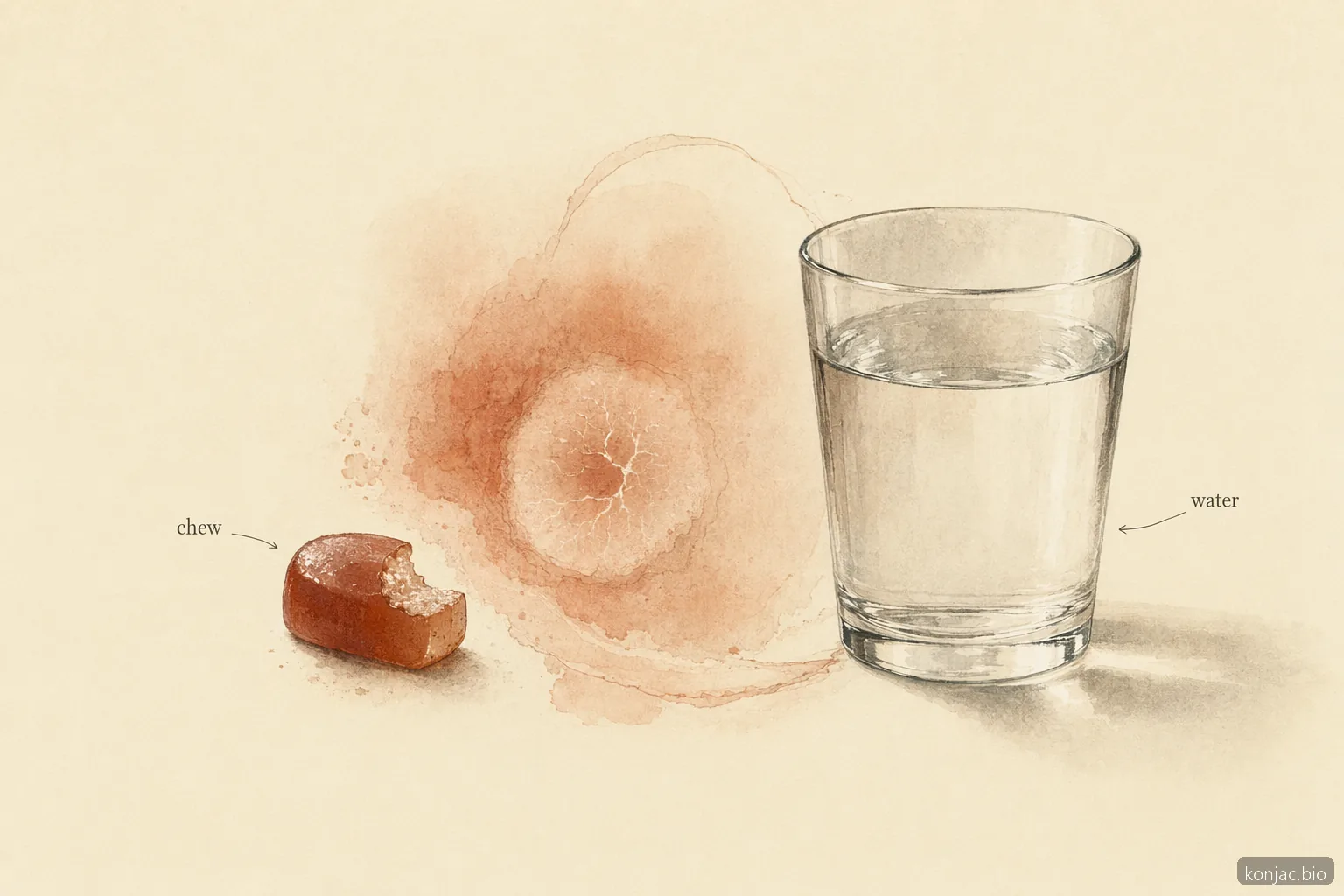
Glucomannan also absorbs water. EFSA noted conditions for a weight-management claim that include consuming glucomannan with 1 to 2 glasses of water before meals, which reflects hydration and swallowing considerations for concentrated formats EFSA opinion. Gummies are not powders or capsules, but high-fiber formats still need sensible serving sizes and clear use directions.
Quality controls should include microbiological specifications, heavy metal limits, allergen statements, particle size, viscosity grade, and lot traceability. For finished gummies, brands should also test water activity, pH, shelf-life texture, packaging migration where relevant, and nutrient content if fiber claims appear on the label.
Formulation checklist for konjac gummies
A strong konjac gummy brief should define the texture target, active fiber dose, process window, label market, and quality documents before pilot batching begins.
Start with the product type. A confectionery gummy may use konjac mainly for chew and water control, while a functional fiber gummy may need a measurable glucomannan contribution per serving. Dietary fiber declarations in the United States depend on FDA definitions and accepted analytical or scientific support for the fiber ingredient FDA fiber.
Use this checklist when briefing an R&D team or supplier:
- Texture target: soft chew, elastic chew, firm bite, quick melt, or long chew.
- Konjac grade: viscosity grade, particle size, purity, hydration speed, and odor profile.
- Co-gelling system: pectin, carrageenan, agar, starch, gelatin alternative, or blended hydrocolloid.
- Process: cold dispersion method, cook temperature, shear level, holding time, deposit temperature, and drying time.
- Label market: United States, European Union, United Kingdom, Gulf, China, Japan, or multi-market pack.
- Claims: fiber claim, vegan claim, sugar reduction claim, or EFSA-style glucomannan claim if conditions are met.
- Safety: serving size, target user group, warning language, choking-risk review, and packaging instructions.
- Documentation: specification, certificate of analysis, food safety certification, allergen statement, non-GMO statement if required, and traceability records.
Processing usually fails for predictable reasons: insufficient dispersion, excessive acid exposure, incompatible minerals, too much free water, or a mismatch between gum grade and cooking time. A pilot run should record batch viscosity, deposit behavior, demolding time, final moisture, pH, water activity, and sensory texture at day 1, day 30, and end of shelf life.
For adjacent applications where konjac forms the whole product structure rather than supporting a gummy matrix, see the related guide to shirataki noodles. That comparison helps separate low-calorie noodle gels from confectionery gummies, which have different solids, sweetness, acidity, and bite expectations.
What claims can konjac gummies make?
Konjac gummies can make fiber, ingredient, or glucomannan-related claims only when the formula, serving size, market rules, and wording support the claim.
In the European Union, EFSA evaluated the wording: “Glucomannan in the context of an energy restricted diet contributes to weight loss.” The evaluated conditions include 3 g of glucomannan daily in 3 doses of 1 g each, taken with 1 to 2 glasses of water before meals in the context of an energy-restricted diet EFSA opinion.
That requirement creates a practical issue for gummies. A product would need enough glucomannan per serving to meet the condition, plus label directions that match timing and water intake. Many gummies are positioned as general fiber products instead, because putting 1 g of glucomannan into each serving can affect chew, water demand, and serving size.
In the United States, dietary fiber labeling depends on FDA rules for isolated or synthetic non-digestible carbohydrates and their demonstrated physiological benefit FDA fiber. Brands should confirm whether their specific konjac ingredient, analytical method, and finished-product label align with the intended Nutrition Facts declaration.
A compliant claim strategy usually separates 3 layers:
- Ingredient identity: “made with konjac glucomannan” or “contains konjac fiber.”
- Nutrient claim: fiber source wording, if the serving meets market-specific thresholds.
- Function claim: only where the dose, directions, and exact regulatory wording are supported.
Frequently asked questions
01 Are konjac gummies the same as regular fiber gummies?
02 How much glucomannan should be in konjac gummies?
03 Why are mini-cup konjac jellies discussed separately from konjac gummies?
04 Can konjac gummies be vegan?
05 What documents should a B2B buyer request for konjac gummy production?
- Scientific Opinion on health claims related to konjac mannan and reduction of body weight · EFSA Journal · 2010
- Import Alert 33-15: Detention Without Physical Examination of Gel Candies Containing Konjac · U.S. Food and Drug Administration · 2024
- Konjac Glucomannan: From Molecular Architecture to Translational Applications. A Critical Review of Structure-Function Relationships, Emerging Biomedical Frontiers, and Industrial Challenges · Foods (PubMed) · 2026
- Questions and Answers on Dietary Fiber · U.S. Food and Drug Administration · 2024